Part 1
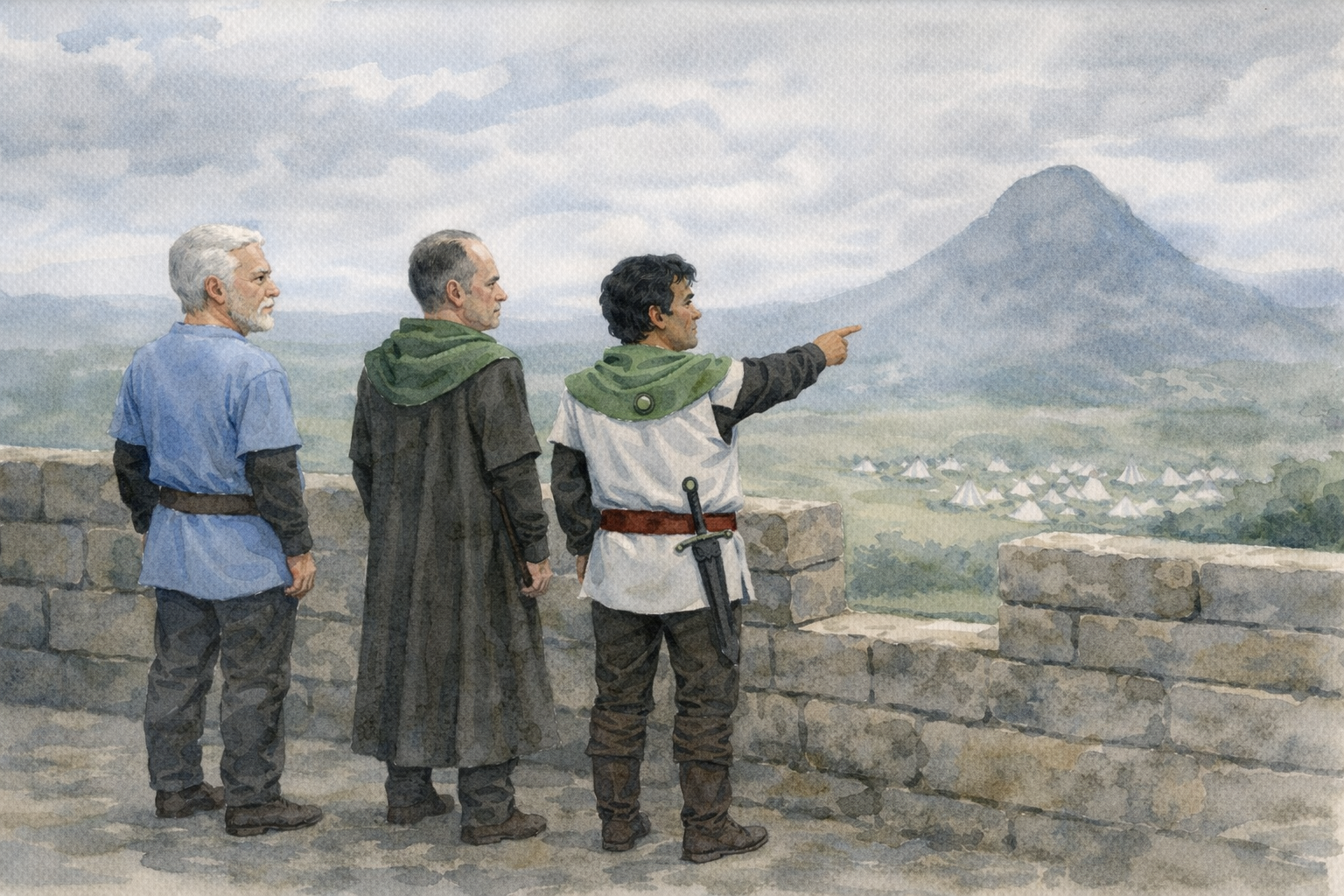
The sky above Vamlodar is heavy with clouds before midday. I stand on the ramparts of Vamlodar Castle with the Paldir Commander, Ser Sagramore, and the young Paldir, Abdul Hakim. Abdul has not yet seen thirty years, while Ser Sagramore has seen twice that number, and I ten more than that. We look across the black slate rooftops of a city of timbered houses, to the stone walls that surround it, and beyond them to the plains between Vamlodar and Daggerpoint, the foremost of the western hills that point towards the city. It is five kem across the plain, and on a clear day we might see the tents of our forces still at its foot and those of the enemy still on its crown.
I am Tharin Saelig, Mayor of Sanctuary, five hundred kem to the east and south. Sanctuary, where three rivers meet to form the great T’Ever River that flows east to Stormhaven and the sea, five thousand kem away across the Arten Commonwealth. Sanctuary is the second greatest city of Narshadow, and until five years ago it was still called Vamsaelig, after my forbears. We have held its mayoralty for generations — not by decree, but because the folk keep trusting us, because leadership in Narshadow has always fallen to the Five Clans. The power of the other clans has been broken by the Empire for a hundred years. But the strong stone walls of Vamlodar and Vamsaelig meant the Empire had to make its peace with Clan Saelig and Clan Lodar, until five years ago, when the wars began again. Vamlodar kept its gates closed until late in the war, but Vamsaelig opened itself to all who fled the Adzar forces. That is how it came to be called Sanctuary. I did not object.
My sister’s son, Danal, is Mayor of Vamlodar now. A good man, though he looks to me more than he should. I have told him often that one day he must trust his own counsel. But the habits of families and clans run deep in Narshadow, and the role of Sanctuary in the war has only deepened the regard folk have for me.
Some call me Tharin Kingmaker now, and only half in humour. It is true that I asked Farjika Pendragon to take the leadership of the clans and of Narshadow, but it was not I alone who made that choice, and Farjika did not take the title king, or queen, or high chief. She accepted the title Protector. That is how we see her. That is what we need her to be.
All this to say: when Farjika Pendragon appeared — black-skinned, outlander, woman as well as warrior — it caused no small stir among our people. And yet they took to her as though it were decreed by some destiny that none quite understood, but all understood was to be obeyed. After Daggerpoint, when she called the healing Light upon the wounded, awe filled every pair of eyes that saw her. But that alone does not explain it. Narshadow has lived long in the shadow of promise and threat.
“Ulf Pendragon will return one day.”
A hundred years ago, a little more than that, a man walked away from his Emperor. The war against the Orakai was over, but the Emperor wished to pursue them into the Nar Mountains and destroy them forever. The Paladin, military seneschal Ulf Pendragon, refused the order, declaring that the Orakai had been provoked by intrusions into their lands and that they were no longer a threat. He said that he would not fight his Emperor, but he would not serve him in an evil cause either. Ulf left on the Great March to Stormhaven, and many of Narshadow and of the Empire followed him.
My grandfather used to say that when Ulf left, he took half our spirit with him. The Empire consolidated its grip on Narshadow. But the legend grew that when things got bad enough, the Pendragon would return. Pendragon is a name from ancient prophecy that somehow became entangled with Ulf.
Ulf never returned. But over the years, from the time of Ulf to the present, warriors of his band, the Paldir, would come to fight alongside the Narshadow Resistance. Never enough to break the truce between the Commonwealth and the Empire, but enough to keep hope alive. And never the Pendragon. Until now.
The decision to make Farjika High Chief, or Protector, was not mine alone. I had discussed it with the clan leaders and with Danal. We have a strong enemy in the Empire, wounded lightly but not dead. And our allies, Orakai and Dwarakai, are also strong. They are friends today, but they have not always been so, and perhaps will not be so tomorrow.
These were our reasons for offering Farjika Pendragon the office. I cannot say what her reasons for accepting it might have been. But there is the great Round Table in the council chamber of Vamlodar Castle. It was gifted to us twenty-five years ago by the Elvakai King, Caladris Whisperwind. He said it belonged here. And when Farjika first saw it, when I saw her run her hand along its surface, reverently, it seemed she recognised it — and stranger still, I felt it recognised her.
I had imagined that the Pendragon’s Paldir would sit at that table. Some did, but she said it would not be a table for Paldir. Danal and I, and the other clan leaders, were invited to sit there. So too were Gore Bloodaxe of the Orakai and Thrain Ironheart of the Dwarakai, or their representatives. The Shaman, Galen Soham, was invited, but he bowed and said that when it was time for him to sit, he would sit, but that time was not now. Galen had helped in the war, but said it was time to return home to the hills. Sagramore Segwardes also wished to return to his duties and ward of Soulhaven in the Commonwealth, but Farjika asked him to stay on until after winter had passed.
In the weeks that followed, I watched how she moved through the duties of command as if politics were her native language. Ser Sagramore and I followed her everywhere, as did Abdul Hakim. Abdul has a remarkable memory. He does not write, but he remembers everything, and at the end of each day he recites what has been said and done for the scribes.
So it was that when she stood before Marcus Vericus, Seneschal of the Adzar Empire, at the top of Daggerpoint, we three were there. A truce had already been negotiated that allowed the Adzar forces to withdraw to Stonekey. Now there was the matter of the Empire’s continued presence in Narshadow.
Both knew the Empire could hold Stonekey. Both knew they could not hold the farmlands or the mountain passes if Narshadow and its allies refused them. They spoke of their power and of their right to hold the land they claimed. Marcus spoke of roads the Empire had built, of the trade those roads enabled, and of the Imperial right to tax and tribute.
Farjika answered:
“Yes, you have Stonekey, and you may have some right to taxes for the roads the Empire maintains. These matters may be discussed. But you have no right to raid the hill villages for slaves, and those you hold as slaves must be freed.”
Yet they did not seem hostile to each other.
Marcus Vericus did not seem sorrowed by the deaths of the Stonekey sorcerers, neither those Farjika cut down when they raised their demons, nor those Hadrin Winterwise slew in the camps above Daggerpoint the night before the battle. Marcus commanded Imperial troops, but he seemed no friend of the College of Sorcerers. I saw it in the set of his jaw whenever they were mentioned.
He spoke plainly at the end:
“The Empire, and its sorcerers, hold more power than you guess, Farjika Pendragon. More than you or your Paldir or your Light Keepers may withstand. You may or may not defeat a commander at the edge of the Empire, but you cannot resist the Empire if it turns all its forces against you.”
Farjika met his warning with calm, but said that on the matter of slavery there could be no compromise. Perhaps a truce to save lives, but there could be no peace between Paldir and slavers. Her passion on this point made me uneasy. The clans do hold some folk in bondage. It is not right. We do not treat our bondsmen and bondswomen cruelly, as the Adzar do their slaves. But we hold power over their lives and freedom. It is our tradition. It is not right.
Later that evening, when we had returned to Vamlodar Castle and I was sitting alone with the Pendragon, I raised the issue of Narshadow bondservice with her, and my concern about her passion. My Lady smiled and said that she had not come to break our traditions, but to bend them towards justice and compassion. In the days that followed, the courtesy that Farjika and the other Paldir extended towards bondservants — greeting them with hai kai and calling elder servants ser and sera — did not go unnoticed. She teaches without a classroom, or perhaps the whole of Vamlodar is becoming a schoolhouse.
“Look! Over there!”
Abdul Hakim’s voice breaks my reverie.
I can barely see them in the distance. A line of horses coming through the grey rain-mist, under a grey sky. That will be Marcus Vericus, this time coming to Vamlodar. The truce has held for a moon and a half, twenty-one days. He comes with a small guard, not a legion. The Pendragon has guaranteed his safety. They will not be harmed. Abdul will inform Farjika Pendragon. Sagramore will send out riders to meet and escort them through our gates. I will prepare hospitality for these men, sodden after their ride. They have been our enemies and are enemies yet, but they come under banners of truce and must be treated as guests.
Part Two
It is the last day of the eighth moonth, called Enki, or in the common style Octavus. Two moonths have passed since the Battle of Daggerpoint, and twenty-two days, one and a half moons, since the Truce.
It is morning, and we have been up before the sun, whose light now streams through the clear glass of the council chamber. While it was still dark, the Paldir, Ser Sagramore, Abdul Hakim, and I — Tharin Saelig, Mayor of Sanctuary and now, apparently, advisor to the Pendragon — sat with Farjika Pendragon and the circle of others who sit with her each morning in the chapel. Following her example, we sat on the stone floor in a silence she only sometimes breaks to give instruction.
Now we three sit here after a modest breakfast with Farjika, Pendragon and Protector of Narshadow. We sit on one side of the heavy table, while on the other side sits the Adzar commander, Legate Marcus Vericus. Beside him is a tall black-skinned man who has been introduced as Corus. Corus also holds the rank of Legate, though it appears to be of a lower order than that of Marcus. His skin is a little darker than Farjika’s, and his hair is short and crisp, like a cap upon his head, while Farjika’s hair tumbles in a tangle of curls, black but streaked with grey about her face and head.
I believe that Corus was, like Farjika, once of Durdessa. But now he belongs to the Empire, as much as she belongs to the Commonwealth and now, perhaps, to Narshadow.
As Marcus and Corus had entered the chamber after us, we had risen to greet them, following the Pendragon’s example.
“Saren Tal,” she had said, meaning Peace to you, touching her hand lightly to her chest and bowing slightly.
“Saren Tal,” replied Marcus Vericus, thumping his chest with a fist. There had been perhaps the slightest hint of a bow from him. The Pendragon had said Saren Tal, indicating respect, not Hai Kai, as she usually did, indicating friendship.
As we sat, I wondered why only Legate Corus — Corus Doudam, as I was to learn later — was at the table on Marcus’s side. As Marcus began, the reason became clear.
“Genericus is dead.”
Farjika nodded. When Marcus did not continue, she did so for him.
“And you must return to Adzar.”
Marcus nodded.
“I must. I am one of his grandsons, one of several, and not the most ambitious. They will vie for the throne, but it is the man the College and Kigam Kalb think the most compliant who will win it. It is not a prize I want, but…”
He looked briefly at Corus.
He said the College the way a man names an illness that runs through a family line. The Pendragon again completed his sentence.
“But if you do not return, your loyalty will be suspect.”
Corus Doudam sat beside him, waiting, unassuming, watchful. I, in turn, watched him, thinking that a Durdessan who had risen so high in the Empire must be spectacularly able.
Marcus looked briefly at Corus and then back again to the Pendragon.
“Two days before my grandfather died,” he began, “he drafted a message for you.”
Only a tilt of her head indicated Farjika’s surprise.
She waited.
Marcus breathed in. Then stood again. Corus stood also.
“It is not the kind of message that could be committed to paper. It was committed instead to the memory of Corus Doudam.”
Marcus nodded at Corus, who stood and began reciting the message. Corus’s voice was calm, measured, without emphasis, as though he had rehearsed this a thousand times in silence.
“Farjika Pendragon, heir to the legacy of Ulf Pendragon and now Protector of Narshadow. Greetings.”
Farjika stood. We all stood.
“By the time you receive this, I will have fallen on my sword. Pray that I may, in time, be received into the Land of Light and Spirit, once I have paid penance in the Land of Flame and Shadow. Ulf, always the comforter, said often enough that none can fall so far that Mercy cannot reach them.
“Ulfric Resolutus, as he was before he became Ulf Pendragon, was once the Paladin at my right hand, urging justice, even as the Sorcerer Kigam Kalb was at my left, urging power. I chose power, and I make no excuses. Enough to say that I became a prisoner of that power, and the magics that kept me alive long beyond my natural span made me almost as cruel as Kalb.
“I extended the power of the Empire north to Valthanas and south to Ethrania. We never attacked Ulf’s new Commonwealth because there were always easier conquests. Ulf was the best strategist I have ever known, and always particularly good at defence. That is not to say that we did not support the barons of Arten against him, but he won that game too. Under the Pendragons and Prime Administrators who succeeded him, the Commonwealth remained too strong to assault directly. But that has changed.
“Now I must tell you that Kigam Kalb and the Sorcerers own the Prelates of the Three Faiths and the Lords of the Senate. Until a little while ago they owned my soul. More than this, they own demons from hell realms farther from God than the Lands of Flame and Shadow. They own demons greater than the ones you turned at Stonekey, and demon-possessed more controlled than the berserkers your forces met at Daggerpoint. Besides this, we have legions stationed in the Gharissan Kingdoms on the Commonwealth’s southern border.
“I never hated Ulfric, and I never hated his successors in the Commonwealth. But for some reason I cannot discern, Kigam Kalb hates the Pendragon and all his successors with a passion beyond reason. I fear that he will break the world to break you.
“I no longer bear you malice. Indeed, I think you may be the Empire’s best hope, and perhaps the best hope for our world. I understand that there is a truce in Narshadow between you and my nephew. I have kept him away from the City, but now he must return. I know that you will not consider him a good man, as your understanding of what is good differs from the Empire’s. But know that he is an honourable man, and he will not break any bond he has made with you. There may come a time when you value his presence in the Empire.
“If you see her, give Euan Mistborn’s sorceress my thanks for the service she did me.
“Live long and well. There are no enemies beyond death.”
Genericus, Emperor of Adzar.
After Corus had finished speaking, no one moved for a while. Then Farjika spoke. Simply. Repeating the words of Genericus.
“There are no enemies beyond death.”
She then gestured for us to sit.
The rest of the meeting raised issues concerning turning the truce into a provisional peace. Provisional, that is, until the accession of the new Emperor and his commands. There was still the issue of prisoners held at Stonekey, and the need to withdraw from occupied villages. Then there was the matter of the Adzar forts along the road from Stonekey to Sanctuary. Some of these were occupied by our forces, and some were still under siege. These matters were raised, but resolution would have to await negotiation between a delegation of Adzar commanders and the full Alliance Council after Marcus had left for Adzar City. Corus would remain to lead the delegation.
That evening, after prayers, after the other Paldir and courtiers and servants had retired, Farjika Pendragon, Ser Sagramore, Abdul Hakim and I sat together in the kitchen, as had become our habit. As usual, Farjika and Sagramore declined the cakes I offered, and Abdul, looking to them, declined also. Only I had the cake, though I should not have at that time. I think I do it to show that I am not Paldir. We all had tea.
It was then that the Pendragon ambushed me by asking me to become her Prime Administrator. She said she could not manage Narshadow on her own. That it would not be right for her to do so, even if she could.
It is said that in the Commonwealth the Pendragon and the Prime Administrator hide behind each other, and I suddenly had the absurd image of Farjika and I running around each other. Then I thought about what the other clan chiefs would say.
“So that is why Tharin Saelig proposed Farjika Pendragon as Protector. One hand washes the other.”
It would please them. This is something they would understand, although it was never my intention. My intention was peace in my older years.
But I could not refuse. Farjika’s proposition was neither request nor command. It was logic. It was needed.